The
Art of Design:
Furniture
& Furnishings
At one time, Trent was filled with stunningly beautiful furniture designed by the greatest international artists. Ron Thom had a passion for total design "right down to the last ashtray." The university planners and Thom were fully in agreement that the "the University should be a place of aesthetic as well as of intellectual excitement." In addition to the designers featured below, Trent University also at one time possessed furniture by Borge Mogensen, Vico Magistretti and Tobia Scarpa.
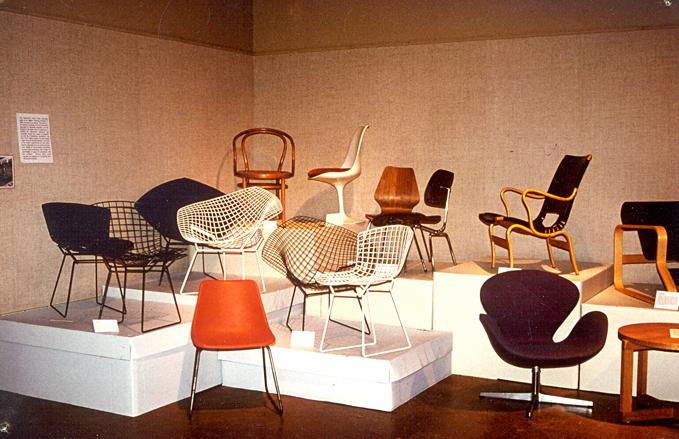
Front, left to right: Robin Day, Jacobsen
Back, left to right: Bertoia (6 chairs), Thonet, Saarinen, Jacobsen, Eames, Mathsson, Aalto
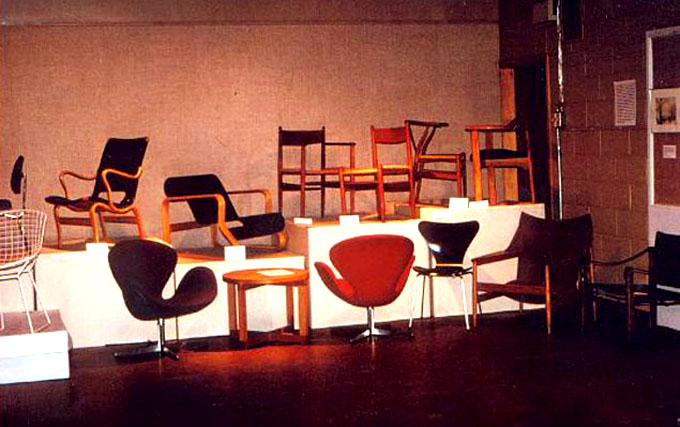
Top,
left to right: Eames, Mathsson, Aalto, Wegner, Wegner, Wegner, Wegner
Front, left to right: Bertoia, Jacobsen, Jacobsen, Jacobsen, [Antelope]?, Klint
In 1989, University Archivist, Bernadine Dodge, on the occasion of Trent University's 25th anniversary, launched a major display of Trent's original furniture at the Peterborough Centennial Museum and Archives. The display, "Trent: The First 25 Years, 1964-1989," featured many of the original chair designs. Gathering examples from throughout the University proved to be a daunting task, as most of the items had been removed from their original locations, many no longer existed, and others were damaged.
Photo credits: Bernadine Dodge
Modernism and the Iconic Chair
"The chair is an object steeped in connotations; it confers status on its user, it can possess varying degrees of intellectual content...The chair more accurately mirrors the social and economic contexts within which design has evolved in the twentieth century."
Charlotte and Peter Fiell, Modern Chairs (Cologne: Taschen, 1993), p.7-8.
Intricately linked to Western industrial capitalist society and connected to ever evolving technologies, the designed chair represents the most accessible paradigm of Modernity. Far from being "just another piece of furniture" the chair bears the weight of social and economic contexts, revealing the sociopolitical intentions of both interior designers and individual consumers. The design of the chair most often represents a conversation between aesthetics and functionality; between handcraft and machine; between historicism and Modernity and between austerity and luxury.
Chairs chosen for Trent University by architect Ron Thom are very properly regarded as works of art. The designers were of international repute; examples of many of the chairs which furnished the Trent colleges, residence rooms and library are currently preserved in the MoMA. Few survive at Trent, though some have been preserved through the efforts of a few individuals. Photographs of any extant examples were taken in 1989 and form the basis of this overview of the treasures we once possessed.
Cranbrook Academy of Art
The Cranbrook Academy of Art was founded in 1925 by George Booth, a Canadian, and is located in Detroit, Michigan. Several of the designers of Trent's furniture were students there, including Florence Knoll, Charles Eames, Harry Bertoia, and Eero Saarinen.
Booth first met architect Eliel Saarinen in 1923 and together they established a utopia-inspired design community committed to the hand craft ideals of the Arts and Crafts movement flowing into the application of linguistics theory on design concepts.
|
The
Designers
|


