Lady
Eaton College
Japanese influences are evident throughout
Lady Eaton College. Two low zigzagging arms reach out from a pivotal administration
area to embrace a semi-enclosed court yard. Inside, there is a meditative air
and a warmth to the central sunken meeting room. The modest, human proportions
of the building situated at the base of a drumlin lend themselves to quiet reflection.
This college is also built of concrete but warmed by wooden-roofed walkways.
The exterior construction design used board-marked smooth concrete rather than
the expensive rubble aggregate used for Champlain College and the library.
Lady Eaton College, like Champlain College,
is noted for its orientation towards, and its anchorage within, the landscape.
Thom allowed nothing to interfere with the smoky illusion of a concrete building
spread along the base of the drumlin. Arthur Erickson wrote in Canadian Interiors
(June 1969) that "the gentleness of the terrain is echoed in his compositions,
in the way the buildings fold in upon themselves around their intimate courtyards..."
Thom banished his parking lot to an area
sheltered by trelliage from the courtyard at Lady Eaton College. As with all
his buildings, the car has been "virtually excluded" and "pocketed
into small lots so that it seems a diminutive service, rather than an aggressive
threat to the university." (Erickson, 1969).
Excerpts from the press release
announcing the building of Lady Eaton College, 30 June, 1965
The first new college for women on
the permanent site of Trent University is to be named Lady Eaton College, it
was announced today by the President and Vice-Chancellor, T.H.B. Symons. The
name honours Flora McCrea Eaton, one of the original honorary sponsors of Trent
University and a native of the Trent Valley, who has maintained close ties with
the area and an active interest in the University.
Lady Eaton College will be a residential
and teaching college for about 259 women including both resident and non-resident
students, a number of graduate students, and members of the teaching and administrative
staff. Preliminary plans for the College include lecture and seminar rooms,
tutorial offices, library, common rooms, and dining hall. In addition to residential
accommodation, Lady Eaton College will contain some special facilities for non-resident
students, living in Peterborough and the surrounding area, who will be active
members of the College. Detailed planning for the College is now being done
by a committee of the University staff under the chairmanship of Professor Robert
Chambers.
Lady Eaton College will be the second
of the series of residential and teaching colleges which Trent University plans
to build on its 1400-acre campus at Nassau on the Otonabee River on the northern
outskirts of Peterborough...
Peterborough
Ontario
Construction
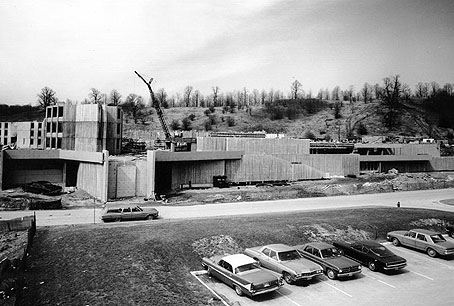
Photo credit: Parks' Peterborough
|
... the college...
is the basic building block of the campus. It is at the core of Trent's
basic philosophy of education... Every member of the university will belong
to a college. Each college will represent every discipline, and each college
will to a great extent be autonomous...
Ron Thom
Architecture and the College, p.2 |
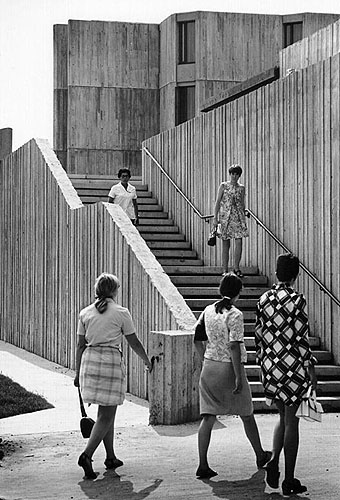
Photo credit: Roy Nicholls Photographer |
"The
Pit"
Lady Eaton College
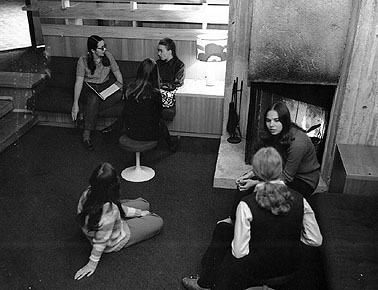
Photo credit: Parks Studio |
Lady
Eaton College at the foot of the drumlin
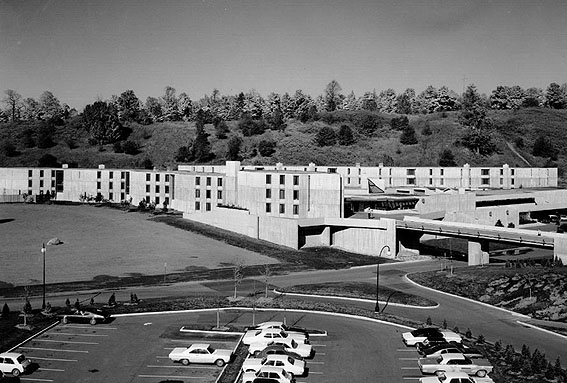
Photo credit: Parks Studio
Original
Plans for Lady Eaton College
|
Description
of Structure
The building is a simple load-bearing
wall and poured concrete slab system.
Rooms of the resident wings
are wood frame construction with built-up asphalt roofing. The roofs over
the series of rooms that comprise the Dining Hall, and a similar roof
over the Senior Common Room, are of wooden fan truss construction on a
central support.
Materials and Finishes
It is intended to construct
all exterior load bearing walls of rubble aggregate concrete. The use
of precast concrete panels for the walls is being considered.
Interiors of walls and non-structural
interior partitions, which are of clay tile, will be rough cast plaster,
unpainted.
Floors are carpeted throughout
for ease of maintenance and sound insulation, except in the Dining Hall
or areas where traffic is heavy such as the Gallery. The floors of washrooms
and other service areas are vinyl-asbestos tile.
Windows are painted steel, with
patented sealed double glazing used throughout.
Ceilings are exposed smooth
finished concrete, except in the upper store of the residence wings where
plaster is used.
The covered walkways have flat
wood frame roofs with built-up asphalt roofing, supported on rubble aggregate
concrete pillars from one side of the walkway only. These light flat roofs
will be used in other parts of the College such as the Dining Hall, Junior
Common Room and Library, in contrast to the load-bearing walls of the
residence wings.
The Principal's House is of
wood frame construction, and has similar light wooden roofs to those of
the main college buildings. Rubble aggregate concrete will be used in
a minimum number of areas, such as the fireplace.
|
(Taken from a report prepared
by Thompson, Berwick, Pratt, R.J. Thom, Architect, 26 May 1966. Some of the
design elements were changed as construction progressed; for example, no separate
Principal's House was built, and rubble aggregate construction was abandoned
in favour of smooth concrete for this Thom building.)