Thomas J. Bata Library


The library is seen by many to be the most successful and beautiful Thom building at Trent. It is located at the heart of the campus, close to - nearly over - the Otonabee River. More rigorously modern than Champlain College and thus devoid of the architectural references to the cloistered medieval retreat, the library does share some of the same elements: textured exposed rubble aggregate concrete walls, wooden and concrete overhangs shading the windows, and a soaring, light-filled atrium reminiscent of the scale of Champlain's dining hall.

The library is linked to Champlain College, Lady Eaton College and the university buildings on the east side of the river by a broad, red-tiled plaza with tiered steps leading to landings and bridges. The bold horizontal lines of the stairways echo the horizontal lines of Bata Library. The building itself implies a stolid immutability, both elegant and severe. The principle motif is the square: tiers, turned on an axis within a base square thus presenting eight corners to the viewer.


Excerpts from a press release announcing the construction of the University Library, dated November 16, 1967

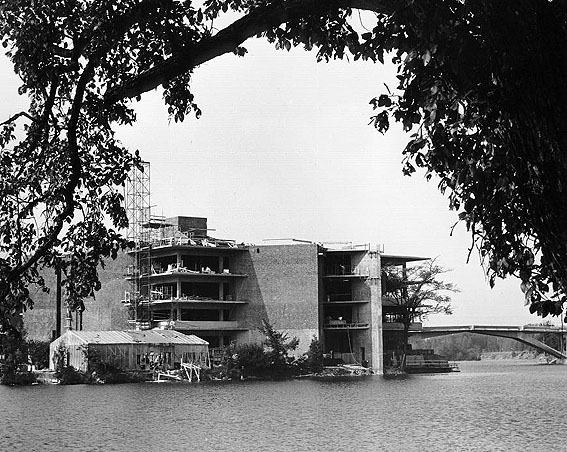
Trent University's main library, located at the geometrical centre of the Nassau campus, has begun to rise on the west bank of the Otonabee River.

Its site has been chosen so that it will be at the crossroads of most of the pedestrian traffic on the campus.

...

The University Court, to be located between the library and Champlain College, will be a large, open area designed to serve as a natural meeting place for members of the University, said President Symons. It will be the western terminus for one of the two pedestrian bridges over the Otonabee River linking the east and west sections of the campus. The court may be used for outdoor convocations and other special University functions.

The first phase of the University Library, which is now under construction, is a four-story building which will provide shelf space for about 350,000 volumes, seating space for up to 1,000 students at a time, and study carrels for faculty and for graduate students, as well as many other related library facilities.

The interior area of this first phase of the University Library will total nearly 120,000 square feet, divided more or less evenly among its four floors.

The ground floor will accommodate language laboratories and a small film theatre, in addition to areas for bindery and storage, an audio-visual department, maps and microfilm, government documents, and general office and storage space.

The main entrance to the Library will be on the second floor, from the University Court. The central circulation desk will be located here, as will be the acquisitions and cataloguing offices, bibliography and reference sections, and associated reading and work rooms.

On the third and fourth floors will be the main library stacks, reading and study areas, and study carrels for graduate students and members of the faculty. A part of the fourth floor will be made available for university administrative for a few years, until the construction of a Senate House can provide this accommodation.

...

The library building, which has been designed by Trent's master planning architect, Mr. R.J. Thom, is of a practical but striking design, with one corner of the building rising directly from the river bank and projecting slightly into the river. Its exterior finish will be board-marked concrete and rubble aggregate -- finishes similar to those on the Chemistry building on the east side of the river and Champlain College which is to the north of the Library and University Court.

The Master Plan of the University calls for subsequent additions to the Trent Library as the University expands...

Peterborough
Ontario


Construction 1968

Library construction

... The Library is considered to be the central building of the campus, the one building used by all members of the University. It has therefore been placed at the confluence of all pedestrian traffic, making it the proper hub of the University.Ron Thom,
Master Planning Architect
Master Plan,
Trent University
23 April 1964


Library and Podium (University Court)
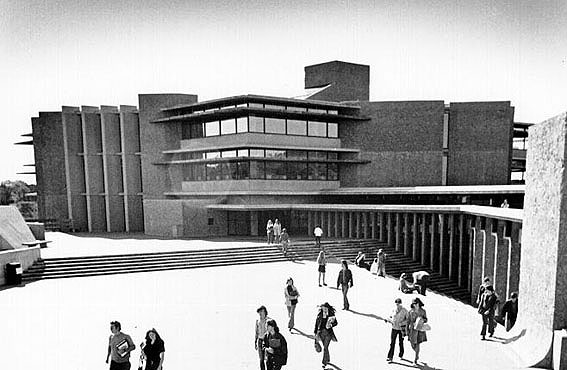
Library & Podium

Photo credit: Roy Nicholls Photographer


Podium (University Court) linking
Champlain College and Thomas J. Bata Library
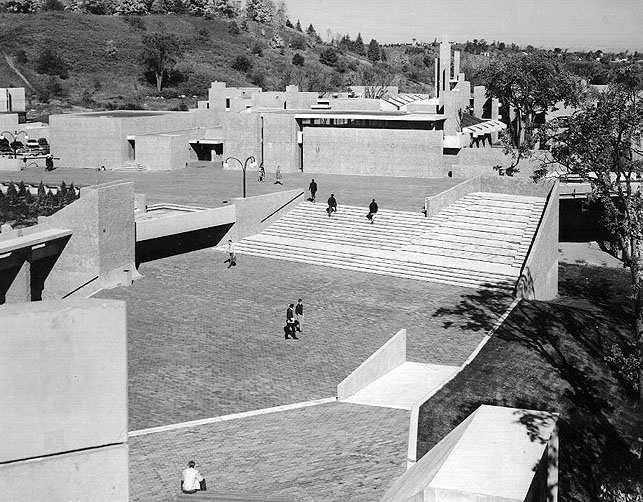
University Court

Photo credit: Parks' Studio

...Main entrance to the Library is on the second floor, from the University Court, a large open area linking the Library to Champlain College and to the footbridges which lead to the Chemistry Building and to Lady Eaton College.

Trent University Press Release, September 3, 1969


Bata Library: Interior Architecture and Furnishings

"All workmanship shall be of the highest quality..."

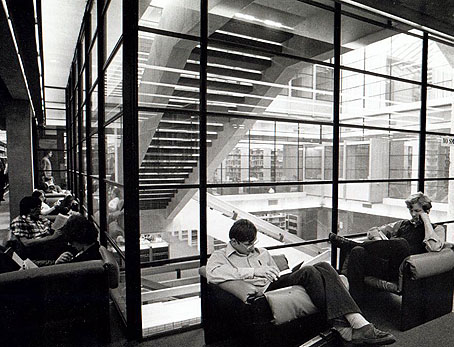
Library Atrium
(photo includes "Prague" armchairs from the Bentwood Chair Company)

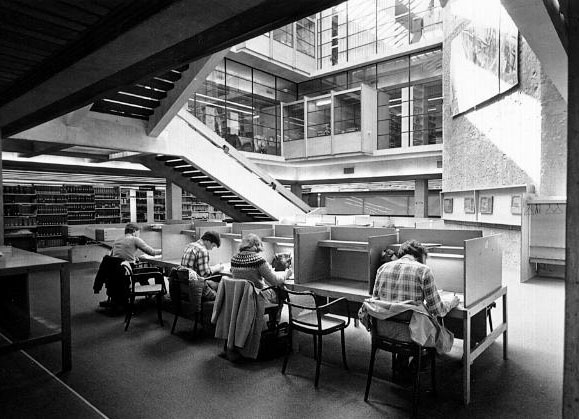
...The centre is an open square, completely covered by a skylight, that contains elevators and stairs. This open space has been guarded jealously from those who itched to fill it in for all the practical reasons, as it is a vital visual connection joining various parts of the library.

Ron Thom
Architecture and the College, p.7

Library interior


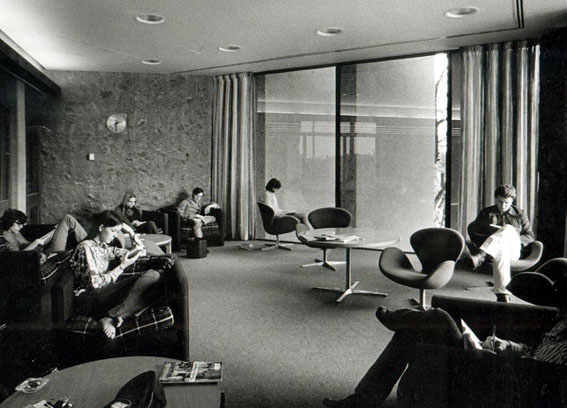
The "Swan" chair designed by Jacobsen;
charcoal full-end tuxedo chairs from Fry & Blackhall

Library chairs - "The Swan", and tuxedo chairs

Photo credit: Roger Jowett


The "Swan" & "Falkenberg" easy chairs, 1988

"The Swan" and Falkenberg chairs

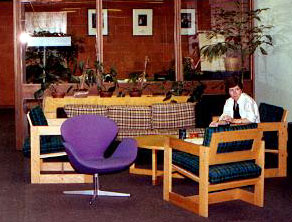
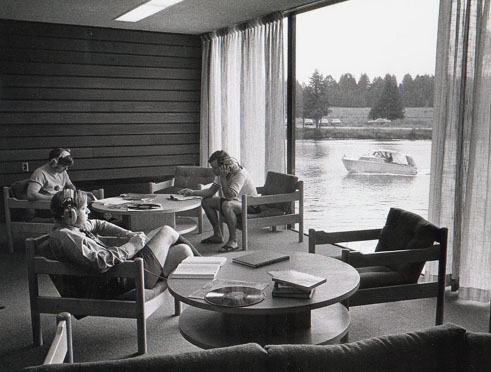
The "Swan" (purple chair) was designed by Arne Jacobsen; The "Falkenberg" easy chairs and sofas were constructed of flat cut red oak, with natural lacquer finish; original colours of green or red were chosen for the upholstered seats and back cushions.

Photo credit: Bernadine Dodge


Muller & Stewart Easy Chairs

Muller & Stewart chairs

Photo credit: Roger Jowett

The "Renaissance" Muller & Stewart easy chairs were designed with a satin lacquer finish and upholstery in lackawana leather. Twenty-seven were chosen for Bata Library; 16 were placed around the stairwell on the 3rd floor, and 11 on the 4th floor. In 2003, 13 remaining chairs were removed to be refurbished.

Muller & Stewart also constructed custom-designed coffee tables; these tables were located in the Library staff lounge in 2003.


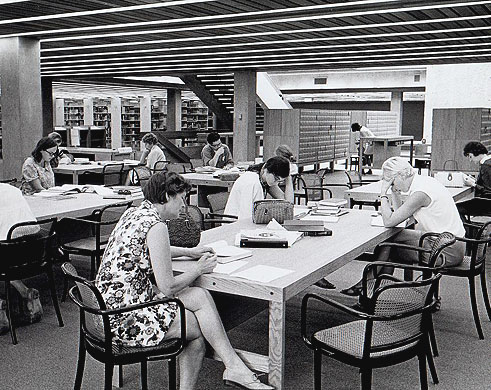
The "Prague" Chair

A total of 566 "Prague" armchairs manufactured by the Bentwood Chair Company were chosen for Bata Library. These chairs feature a black lacquer finish and nylon cane seat and back.

The original Library carpet, of charcoal coloured wool, was manufactured by Brinton.

Prague chair

Photo credit: Roy Nicholls


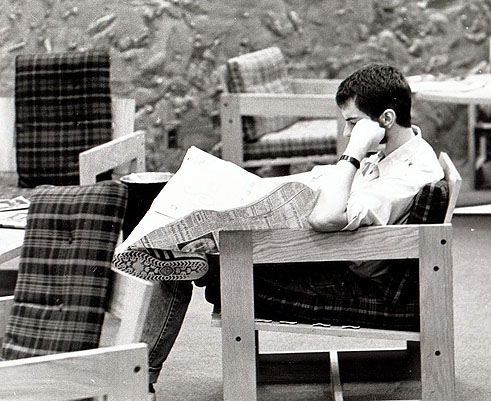
"Falkenberg" Chair

Falkenberg chair


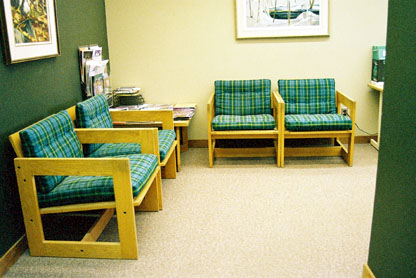
These "Falkenberg" easy chairs are manufactured from flat cut red oak. They feature a natural lacquer finish and upholstered seat and back cushions in green or red.

These chairs were chosen for Bata Library. Many still exist in the Library.


Falkenberg chairs

Photo credit: Bernadine Dodge


"Conran" (Habitat) Easy Chairs and Sofas


Conran sofa

Photo credit: Bernadine Dodge

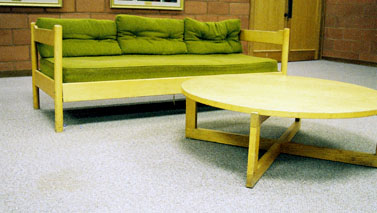
The "Conran" (Habitat) easy chairs were manufactured with a beech frame in a natural lacquer finish, and upholstered in orange wool.

Complimentary sofas were upholstered in an olive colour.

These were chosen for the staff lounge on the 1st floor of Bata Library. Also purchased for the lounge were 14 Bertoia "Diamond" chairs, upholstered in wool.


Conran & Habitat

Photo credit: Roy Nicholls


Divided Study Tables


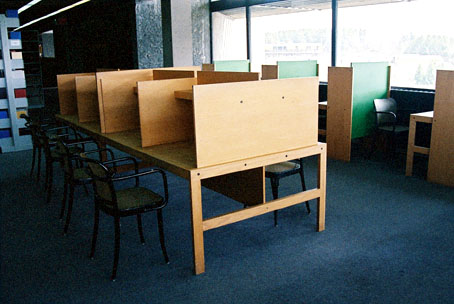
These divided study tables and individual study cubicles were amongst the custom built furniture designed by Thom for the library. They are constructed of red oak.


Divided study table

Photo credit: Bernadine Dodge


Library Work Tables and Stock Library Chairs

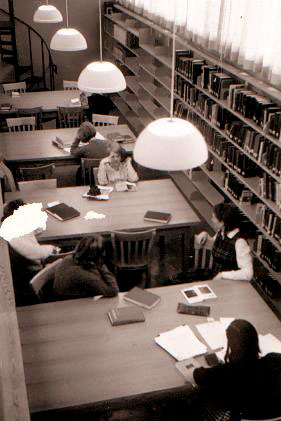
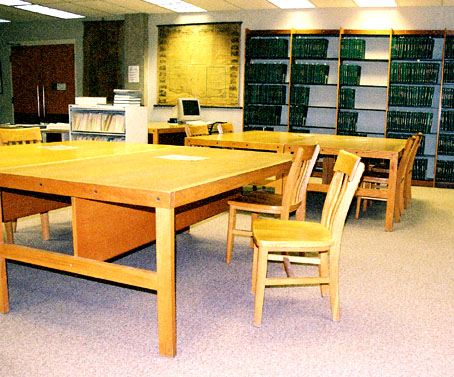
It is obvious that these library chairs (see below) were chosen by Ron Thom, but little detail is known about them. They are constructed of red oak and were manufactured by Henderson Manufacturing and were first used in Rubidge Hall, and then moved to Bata Library. Ron Thom included in his "custom-designed furniture" list, coffee tables, study carrels, desks, coat racks, dictionary stands, atlas stands, and, of course, the familiar study tables (see below, right). All these furnishings adhere to Thom's precise specifications and are constructed of red oak.

Library work tables at Rubidge Hall

Photo credit: Neil Rodgers

Library work tables in the Archives Reading Room

Library work tables

Photo credit: Bernadine Dodge