| “The
Abbey Theatre for the last few weeks has been playing to full
houses…” 1 |
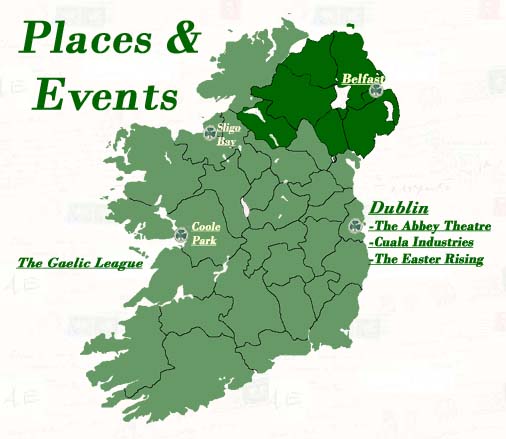
| The Abbey Theatre, or the Irish National Theatre, was founded by W.B. Yeats & Lady Augusta Gregory in 1904, with money from a Miss Horniman, (a unionist whose money was conditional in that there were no politics involved). The theatre was named for the street it was built on, Lower Abbey Street, in Dublin. A significant part of the Irish Renaissance the theatre was conceived to represent and inspire Irish Culture. By 1910 it did not need the monetary support of Miss Horniman; therefore when she threatened to pull out many were relieved. It was a near impossible task to represent Irish culture in such a volatile time and the definition of "politics" was too vague. The Abbey Theatre had already sparked controversy with Synge's Playboy of the Western World. To many it seemed the play was mocking the Irish people which was not the intent of the author. Riots broke out in both the Abbey Theatre Premiere and in North America. In 1924 it became the first state sponsored theatre in the English speaking world. Although the original building burned down in 1951 the theatre was rebuilt and it is still supporting and inspiring Irish culture. Click here to view an Abbey theatre program from August 1923. |
|
Coole Park was the property owned by Lady Gregory in the county of West Galway. William Butler Yeats spent over 30 summers there and it was here that the first mention of a National Irish Theatre was born. |
| The Cuala Press (formerly of Dun Emer Industries) |
 |
| "Five lines of text and ten pages of notes about the folk and the fish gods of Dundrum. Printed by the weird sisters in the year of the big wind." 2 |
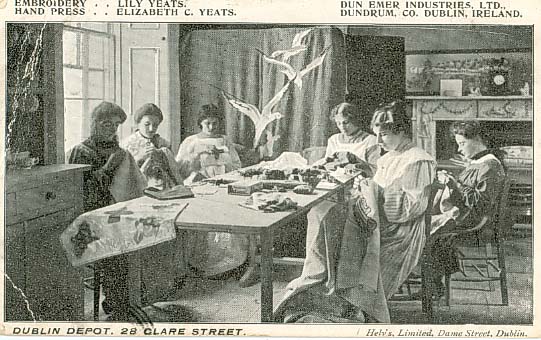
Dun Emer industries was created by Evelyn Gleeson in 1902 with the help of the Yeats Sisters, Elizabeth and Lily. Lily, with Gleeson, worked at the embroidery while Elizabeth started a printing press. Their first publication was William Butler Yeats' "In the Seven Woods". Despite the distaste the sisters had for each other, their distaste for Evelyn Gleeson was even greater. They left Dun Emer in 1908, taking the printing presses with them, and began The Cuala Industries. The Cuala printing press continued to make some of the most beautiful and important prints of Irish Renaissance inspired by and a part of the Arts and Crafts movement. Besides books, Cuala printed Christmas cards and Broadsides (otherwise known as a broadsheets). The Cuala Printing Press was important not only to Irish literature, but also for many women in the area. Cuala, and Dun Emer before it, employed nearly all women. This helped to widen the acceptable working opportunities for women in the area. The Yeats sisters; however, could not be considered suffragettes, in fact they seemed to have little patience for them. Their contribution to the history of women's work is undoubtedly important. |
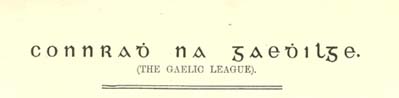
The Gaelic League's goal was to promote the use of Gaelic without being involved in politics. This allowed the league to focus on cultural aspirations and to go unnoticed by the British Government. The League did play an important political role, despite their policies. The Sinn Féin were quick to understand the League's influence over the general populous and used the same logic to explain the need for an Irish Republic. The league was founded by Douglas Hyde & Eoin MacNeill in 1893. Hyde was the first president of the league until 1915. It became a popular way for people who left Ireland to hold on to their past, as well as people still in Ireland. The Gaelic language had been on the verge of extinction since the 17th century. By the early 19th century it was only used in isolated rural areas and Gaelic became associated with 'backwardness' and poverty. The Gaelic League and the Irish Renaissance would subvert these ideas about the Gaelic Language and help it to achieve an honourable status. There is a letter from the Gaelic League which the above graphic is from. Shane Leslie discuses the Gaelic Question in Letter 4. There is also a letter entirely in Highland Gaelic. |
“…living in Ireland requires courage.”3
|
| Irish history is a volatile landscape. The Irish literary Renaissance is an important part of this landscape as it was used to inspire and educate those fighting for Home Rule and Independence. Ireland saw itself as being essentially different from the rest of Great Britain. A hatred for all things English was not unusual: rumours that The Famine was an evil English plot of extermination were spread; industrialization and religion were also focal points (although in the beginning even protestants joined the Gaelic League still appreciating their Irish Heritage). Focusing on this difference at the turn of the century the Gaelic League and the Irish Republican Brotherhood (IRB), among others, sprung up celebrating the distinct Irish language and history. Many of the members turned to politics and began fighting for Home Rule in the British Parliament under the Sinn Féin ('we ourselves') party. In 1912 a Home Rule Bill was brought forward but dropped due to Ulster, the only rich industrial county in Ireland, promising to fight if necessary to stay a part of Great Britain. |
| I had a letter from Lady Gregory in which she said that she would stay in her house in W. Galway & not follow the example of her fleeing neighbours, for she thought that Ireland was 'never so interesting.' 3 |
When the Great War began in 1914 the Irish Home Rule movement was meant to be put on hold; however, on Easter 1916 the Irish Republic was declared by the Republicans, the Irish Volunteers of the I.R.B. and members of the Citizen Army. They occupied Dublin for five days during which time the city was shelled and burnt out by the British. Fifteen of the sixteen leaders were shot by firing squad, crushing any respect that Catholic Ireland had left for Great Britain. Sinn Féin refused their seats in Parliament, and created their own Irish Parliament, ‘Dail Eireann.’ Heavy guerrilla warfare followed until 1923 when Britain acknowledged the Irish Free State as a dominion, which excluded Northern Ireland, and therefore the prosperous city of Ulster. The Irish Free State declared itself a Republic in 1949, amid more controversy and the island remains divided until the present day. |
| “I will arise and go now, and go to Innisfree,” 3 |
Sligo Bay - Sligo was an important feature of the Irish Renaissance. It was hit hard during the famine and those that remained felt particularly loyal to Ireland. Doulgas Hyde, president of the Gaelic league and eventually Ireland, was born there. The Yeats children spent whimsical summers there at their Pollexfen grandparents' home. It was this idealized childhood at Sligo Bay and the stories they heard there that W. B. Yeats and Jack Yeats drew on for many of their artistic endeavours. Their parents, John Butler Yeats & Susan Mary Pollexfen met here on a summer holiday. Innisfree, made famous by W.B. Yeats is in Sligo Bay, as is Rosses Point, (discussed in Letter 3, W.K. Magee to DeLury) and Lissadell House where Eva Gore-Booth's family lived. W. B. Yeats' body now lies under Ben Bulben also in Sligo Bay. |
| 1 E.C.Yeats to De Lury, August 11, 1934. Letter 45. back |
| 2 Douglas Hyde, Christmas, 1911. back |
| 3 John Butler Yeats to DeLury, January 21, 1921. Letter 29 back |
| 4 Joyce, James. Ulysses. page 13 back |
| 5 W.B. Yeats The Lake Isle of Innisfree back |